
GraphJudge: Measuring How Agents Collaborate
Measure how, not just whether
About AgentBeats & Agentic AI Learning
GraphJudge is built for the AgentBeats competition, part of the RDI Foundation’s initiative to advance agent evaluation infrastructure. AgentBeats establishes a standardized framework (A2A protocol) for benchmarking AI agents through competitive and collaborative tasks.
This competition runs alongside the Agentic AI Learning MOOC—a comprehensive course teaching agent system design, evaluation, and deployment. The course materials at docs.agentbeats.org and docs.agentbeats.dev/tutorial provide hands-on experience building green (assessor) and purple (evaluated) agents using the A2A protocol.
GraphJudge contributes to this ecosystem by introducing graph-based coordination assessment—a novel evaluation methodology that complements existing task-completion benchmarks with structural analysis of agent interactions.
The Problem: Success Isn’t the Whole Story
When you evaluate multi-agent systems today, you typically ask: “Did they complete the task?” But here’s what that misses—two agents might both succeed at a task, yet one does it through elegant coordination while the other stumbles through with redundant communication and bottlenecks. Traditional benchmarks can’t tell the difference.
Think of it like evaluating team projects in school. Getting an A on the final deliverable doesn’t tell you whether the team collaborated effectively or if one person did all the work while others copied notes at the last minute. We need to measure how agents work together, not just whether they succeed.
Our Approach: Graph-Based Coordination Analysis
GraphJudge is a graph-centric evaluation framework built for the AgentBeats competition that measures coordination network complexity against execution outcomes. We capture interaction traces as agents communicate, then transform these traces into directed graphs where nodes represent agents and edges represent their communications. This isn’t just bookkeeping—it reveals the structure of collaboration and whether agents achieve results through efficient coordination or convoluted communication patterns.
We extract structural metrics that quantify what’s actually happening:
- Centrality: Which agents are coordination hubs vs peripheral participants?
- Density: How connected is the communication network?
- Efficiency: Are agents taking direct paths or bouncing messages around?
These NetworkX-based graph metrics form our primary evaluation tier (Tier 1), complemented by latency analysis that tracks performance bottlenecks. Together, they provide quantitative measures of coordination quality that you can compare across different agent systems.
Beyond Pure Numbers: The LLM-as-Judge Layer
Graphs tell you the structure, but what about the quality of interactions? That’s where our Tier 2 LLM-as-judge comes in. We use real LLM API calls (with rule-based fallback) to provide qualitative assessment of coordination patterns—did agents adapt their strategies? Did they share information effectively? This semantic layer complements the quantitative graph metrics with behavioral insights.
For consistency validation, Tier 3 text metrics measure response similarity across multiple runs, ensuring reproducibility in evaluation.
Origins: Building on Agents-eval
GraphJudge is derived from Agents-eval, a PeerRead-based benchmark for autonomous research agent systems. We adapted its evaluation philosophy—measuring the quality of agent behavior, not just outcomes—to the AgentBeats context. Where Agents-eval focuses on research paper assessment using text similarity metrics, GraphJudge pivots to graph structural analysis for general multi-agent coordination.
This isn’t a fork—it’s an architectural adaptation. We took the core insight that agent evaluation needs multiple complementary metrics and specialized it for coordination assessment through graph theory.
Implementation: A2A-Compliant and Production-Ready
GraphJudge operates as an A2A-compliant assessor, exposing standard endpoints that any purple agent can interact with. The evaluation flow is straightforward:
- Purple agent submits evaluation request via A2A protocol
- GraphJudge captures interaction traces during task execution
- Traces → Directed graph → Structural metrics extraction
- Three-tier evaluation produces comprehensive coordination scores
- Results returned as structured A2A artifacts
The complete agentic graph benchmark architecture is visualized below, showing the full evaluation pipeline from trace capture through multi-tier scoring:
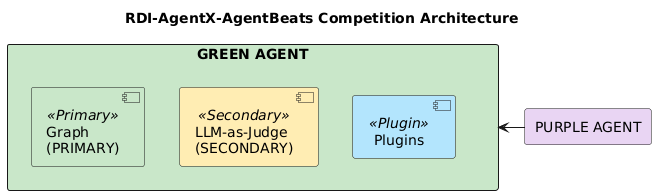
We validated the framework on a baseline purple agent across 5 independent runs, achieving perfect reproducibility (0% variance across all metrics). This isn’t just about proving correctness—it demonstrates that our evaluation is stable and fair for comparing different agent implementations.
Deployment is containerized via Docker, with results integrating directly into the AgentBeats leaderboard for transparent comparison. The agent is registered at agentbeats.dev/qte77/graphjudge.
Why This Matters
No existing AgentBeats benchmark quantifies coordination quality through graph structural analysis. GraphJudge fills that gap by providing researchers with actionable insights into how effectively agents collaborate.
You don’t just get a pass/fail grade—you get metrics that reveal:
- Communication bottlenecks in your agent network
- Centralization vs distributed coordination patterns
- Performance characteristics under different workloads
- Behavioral adaptability through qualitative assessment
This enables evidence-based improvements to multi-agent system design. You can see exactly where coordination breaks down and iterate accordingly.
Development Insights & Contributions
Lessons Learned
Ralph Loop TDD: Enforcing TEST-first then IMPL proved challenging. The
Ralph loop naturally wants to implement before testing, requiring scaffolding
through linting rules, Claude Code skills (.claude/skills/), and core
principles (.claude/rules/) to maintain TDD discipline. Interestingly,
specialized subagents became less critical than initially expected—well-
structured skills and rules provide sufficient guidance for the main agent.
AgentBeats Submission: The submission process is comprehensive—requiring both green (assessor) and purple (evaluated) agents, a main agent repository plus separate leaderboard repository, registration on agentbeats.dev, GitHub workflow permissions configuration, container package tokens for GHCR publishing, Docker image deployment, demo video creation, abstract writing, MOOC article contribution, and finally a multi-page submission form with tight deadline. Each component serves a purpose (reproducibility, transparency, education), though coordinating everything in time tests your project management skills. The resulting infrastructure is well-designed for the agent ecosystem’s long-term growth.
Time Constraints: Competition deadlines unfortunately cut development time
short, limiting implementation of advanced features like interactive graph
visualizations, Phase 2 ART training on traces, and comprehensive plugin
ecosystem expansion. The current release prioritizes core graph-based
coordination assessment with proven reproducibility, establishing a foundation
for future enhancements. The agentic benchmark architecture visualization
(assets/AgenticBenchArch.png) documents the intended full system design.
Technical Contributions
GraphJudge introduces three novel elements to AgentBeats:
- Custom trace engine: Captures interaction patterns during task execution, transforming A2A message flows into directed graphs for structural analysis
- Network complexity scoring: Combines graph metrics (where lower complexity often indicates efficient coordination) with LLM-as-judge qualitative assessment of MAS execution quality
- Plugin architecture: Future-ready extensibility enabling domain-specific evaluators—demonstrated through the text metrics module designed for Agents-eval’s PeerRead dataset assessment
This architecture balances quantitative structural analysis with qualitative behavioral assessment, while remaining extensible for specialized evaluation contexts.
Categories & Contribution
Competition Categories: Multi-agent Evaluation, Research Agent
Core Contribution: First AgentBeats benchmark measuring coordination quality through graph structural analysis, enabling researchers to understand not just if agents coordinate, but how effectively.
GraphJudge pioneers agentified benchmarking for multi-agent systems—using automated evaluation agents to assess coordination quality. This approach is demonstrated through integration with agents-eval, a research MAS that evaluates autonomous agents on the PeerRead dataset. By combining graph-based structural metrics with domain-specific evaluation plugins, GraphJudge establishes a framework where assessment agents can be specialized for different contexts while maintaining consistent coordination analysis.
Competition Compliance
GraphJudge meets all official AgentBeats competition requirements:
- A2A Protocol: Universal agent interface with standard endpoints at
/.well-known/agent.json - Docker Deployment: Containerized for
linux/amd64, published to GHCR, accepts CLI args (--host,--port,--card-url) - Reproducibility: Fresh state per assessment, task ID namespacing, documented across 5 validation runs
- Leaderboard Integration: DuckDB queries extract graph metrics, coordination scores, and similarity measures from published results
Judging criteria alignment: Technical correctness (A2A-compliant, typed, tested), reproducibility (0% variance documented), benchmark quality (graph metrics reveal genuine coordination patterns), evaluation methodology (three-tier quantitative + qualitative assessment), innovation (first graph-based coordination benchmark in AgentBeats).
Agent Registry: agentbeats.dev/qte77/graphjudge
Repository: github.com/qte77/RDI-AgentX-AgentBeats-Competition
Leaderboard: github.com/qte77/RDI-AgentX-AgentBeats-Competition-Leaderboard
References: Competition Page | AgentBeats Tutorial | Green Agent Template | Documentation