
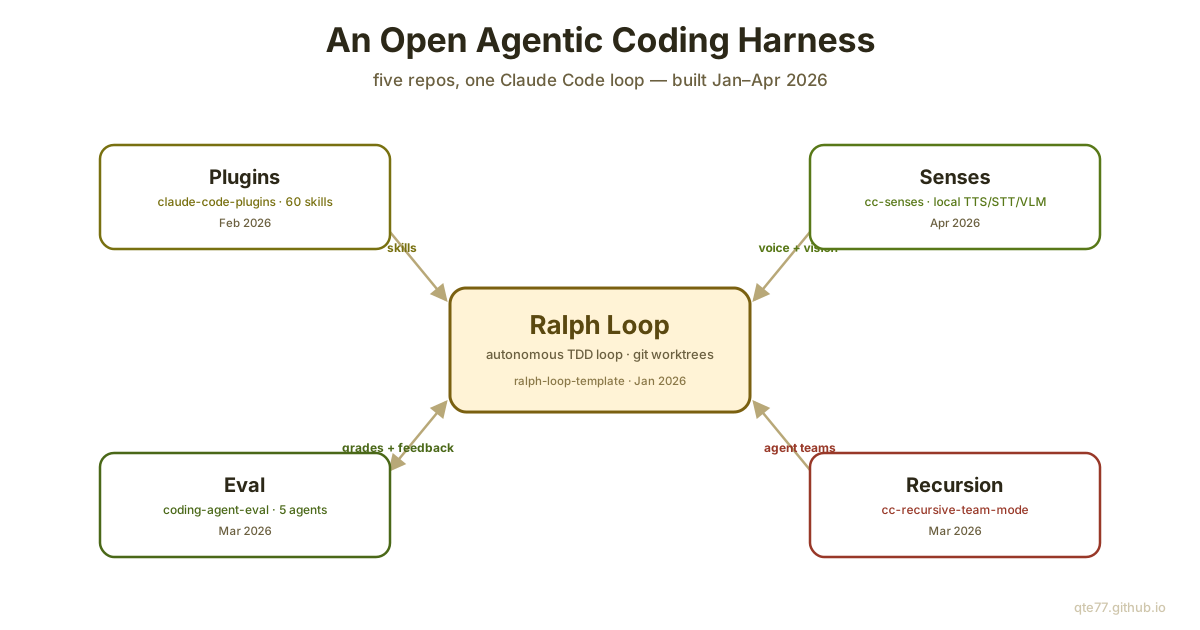
TL;DR. Over four months (Jan–Apr 2026) I built five open repos that turn Claude Code into an autonomous coding harness: a loop that implements stories test-first in parallel git worktrees (ralph-loop), a plugin marketplace that arms the agent with 60 skills (claude-code-plugins), fully local voice + vision so it can speak, listen, and read a screen (cc-senses), a way to nest agent teams by clearing Claude Code’s own recursion guard (cc-recursive-team-mode), and a deterministic evaluator that grades five CLI coding agents head-to-head (coding-agent-eval). All Apache-2.0. This post maps how they fit — with honest creation dates, not a tidy after-the-fact story.
The loop — ralph-loop
The spine is a Bash-driven autonomous loop. ralph-loop-cc-tdd-wt-vibe-kanban-template picks the next story from a prd.json, drives Claude Code through a Red → Green → Refactor cycle (it refuses to mark a story done without a failing-test [RED] commit before the [GREEN] implementation), runs make validate, retries up to three times, and loops until every story passes. With N_WT > 1 it runs several agents in parallel git worktrees, scores each result (stories passed, test count, coverage, lint penalties), and squash-merges the best — optionally with a Claude-as-judge pass and human approval. A LEARNINGS.md is appended after every story and re-read before the next, so knowledge compounds across the run. An optional Vibe Kanban board shows story status live.
It’s Geoffrey Huntley’s “Ralph” technique — he coined it in July 2025 (a bare while-loop re-feeding a fixed prompt), it went mainstream when Anthropic shipped an official Ralph plugin in December 2025, and HumanLayer’s brief history (Jan 2026) tells the full arc. ralph-loop (created 2026-01-18) isn’t Ralph reinvented — it’s Ralph wired to Claude Code with TDD discipline and parallel git worktrees, built as the technique went mainstream. It’s the first piece of this cluster, and the center of everything below.
The plugins — claude-code-plugins
A loop is only as good as what its agent can reach for. claude-code-plugins is a self-hosted Claude Code plugin marketplace — 25 plugins, 60 skills, 2 agents — installable with a single claude plugin marketplace add qte77/claude-code-plugins. It covers language dev loops (python/rust/go/typescript/cpp/embedded), a planner agent and codebase-hardening passes, OWASP/MAESTRO/ATLAS security auditing, a market-research fan-out, and a cc-meta layer for context compaction, session hand-off, and parallel-worker orchestration — the harness’s self-management. Plugins can even ship .js workflow scripts for multi-repo fan-out. Created 2026-02-22.
The senses — cc-senses
cc-senses gives the agent physical I/O it normally lacks, entirely on-device: /speak (TTS via a Kokoro → edge-tts → Piper → espeak ladder), /listen (STT via Moonshine or Vosk with voice-activity detection, injected straight into the Claude Code PTY), and /see (a local vision-language model that describes the screen in ~120 tokens — versus ~1,600 for shipping the raw image to a cloud vision API). It hooks Stop for auto-read and SessionStart/SessionEnd to manage the VLM server. Created 2026-04-04, grown out of an earlier cc-voice-plugin-prototype. No cloud dependency by design.
Nesting agents — cc-recursive-team-mode
Claude Code sets CLAUDECODE=1 and refuses to spawn itself recursively. cc-recursive-team-mode unsets that single variable so claude -p can run as a subprocess from inside a running session, and flips on experimental teams mode for parallel multi-agent orchestration. It captures the subprocess’s stream-json into a typed RunResult (exit code, duration, tokens, cost in USD, tool-call list) and reconstructs subagent trees from the session JSONL. Created 2026-03-23. This is the primitive that lets the harness orchestrate — and audit — agent teams.
Measuring it — coding-agent-eval
You can’t trust a harness you can’t measure. coding-agent-eval runs five CLI coding agents — Claude Code, Cline, opencode, Codebuff, and Gemini/Antigravity — headless, in isolated git worktrees, on identical fixture-backed specs. It grades with three deterministic graders (does make validate pass; how much does the agent’s diff overlap the canonical one; what fraction of changed files stayed in scope) — no LLM-as-judge in phase 1 — and reports mean ± stddev over N=3 runs, in an AgentBeats-compatible schema. It depends on cc-recursive-team-mode to drive and parse the runs. Created 2026-03-23 — the same day as the recursion primitive it’s built on.
The supporting cast
The five repos above don’t stand alone:
ai-agents-research(Mar 2026) — a continuously-updated field catalog of sandboxing, orchestration, and plugin patterns across coding agents; it explicitly links the recursion and eval repos and feeds them.multi-tasking-quality-benchmark(Mar 2026) — correlates WakaTime activity with code-quality metrics to ask whether session patterns (or human-vs-agent authorship) track quality.learnings-ralphy/research-ralphy(Apr 2026) — “ralph offspring”: self-evolving nodes that run the loop on a weekly cron to distill learnings and implement newly-discovered Claude Code features via TDD, writing results back toai-agents-research.Agents-eval(Jan 2025) — the original PydanticAI multi-agent evaluation framework; the lineage this all descends from (see the earlier eval write-ups and the AgentBeats GraphJudge post).context-engineering-template-legacy(Jul 2025) — the precursor: a BRD → PRD → implementation template that predates the formal loop.
What it powers
The harness isn’t the point — what it builds is. Several agentic applications run on the same Claude Code orchestration:
| Application | What it does | Created |
|---|---|---|
| codebase → scientific report | a repo becomes an IEEE-format, citation-backed report via claude -p subagents |
2025-08 |
| market research → GTM | landscape → PMF → go-to-market via CC subagents | 2025-08 |
| office-forge-orchestrator | parallel CC sessions across office projects (invoices, contracts, reports) | 2026-03 |
| job offer → application kit | job feeds become tailored applications via CC Workflow-tool scripts | 2026-06 |
Honest note: the two August-2025 apps predate ralph-loop — they ran on early Claude Code orchestration that the harness later formalized. The point of the harness is to make that orchestration repeatable, testable, and measurable.
Timeline
The whole arc, by repository creation date (git log --max-parents=0):
| Date | Repo | Role |
|---|---|---|
| 2025-01 | Agents-eval | multi-agent eval framework (lineage) |
| 2025-07 | context-engineering-template-legacy | BRD→PRD→code precursor |
| 2025-08 | agentic-market-research-to-gtm | early CC application |
| 2025-08 | agentic-codebase-to-scientific-report | early CC application |
| 2026-01 | ralph-loop | the loop (harness spine) |
| 2026-02 | claude-code-plugins | plugin marketplace |
| 2026-03 | ai-agents-research | research catalog |
| 2026-03 | multi-tasking-quality-benchmark | quality benchmark |
| 2026-03 | cc-recursive-team-mode | recursion / agent teams |
| 2026-03 | coding-agent-eval | deterministic evaluator |
| 2026-03 | office-forge-orchestrator | parallel CC sessions (app) |
| 2026-04 | cc-senses | local voice + vision |
| 2026-04 | learnings-ralphy / research-ralphy | self-evolving ralph nodes |
| 2026-06 | agentic-job-offer-to-application-kit | CC Workflow-tool app |
A clean read: build the loop (Jan), arm it (Feb), then in a single March burst add research, a quality benchmark, recursion, and an evaluator; give it senses and self-evolving offspring in April.
Ahead of the vocabulary, mostly
The vocabulary for this kind of work mostly arrived after the work did — though not always. Lining up when each term was coined or hyped, when HumanLayer documented the discipline, and when the matching repo shipped:
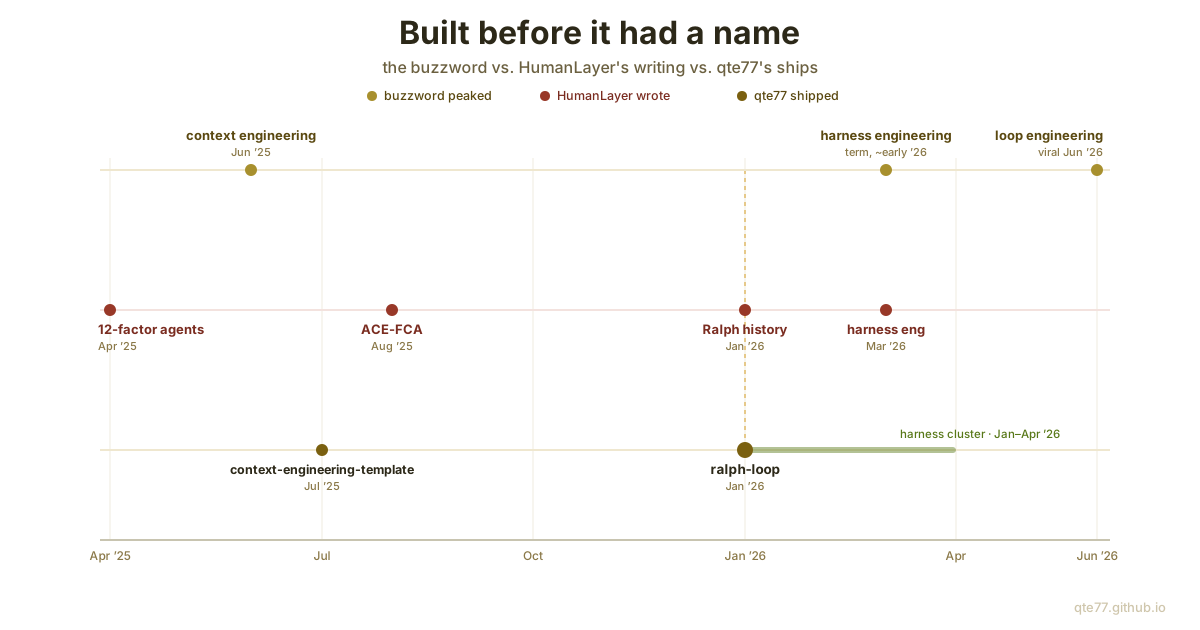
| Term / technique | Coined / hyped | qte77 shipped | Gap |
|---|---|---|---|
| Context engineering | coined Jun 2025 (Lütke, then Karpathy) | context-engineering-template — Jul 2025 |
~3 weeks after — fast adopt |
| Ralph (the technique) | coined Jul 2025 (Huntley); hyped Dec 2025 (Anthropic plugin) | ralph-loop — Jan 2026 |
adopted as it peaked — didn’t lead |
| Loop engineering (the term) | named 2026; viral Jun 2026 | ralph-loop — Jan 2026 |
~5 months before the term |
| Harness engineering | Anthropic’s harness posts, late 2025–2026 | the harness cluster — Jan–Apr 2026 | in lockstep |
Not a priority claim — the ideas, and most of the words, were others’. The honest read is cadence and faithfulness: context engineering adopted within weeks of its coinage; Ralph (Huntley’s, Jul 2025) implemented as it went mainstream — not before it; the broader loop-engineering practice shipped months ahead of that phrase peaking. Fast, faithful adoption, with the occasional genuine lead.
Quick answers
What is the “Ralph loop”? An autonomous agent loop — pick a story, write a failing test, make it pass, refactor, validate, repeat — coined by Geoffrey Huntley (July 2025) and mainstream by year’s end. ralph-loop is a Claude Code + TDD + git-worktree implementation of it.
Do I need all five repos? No. The loop runs on its own; plugins, senses, recursion, and eval are independent layers you add as needed. They share one idea — Claude Code as the execution engine.
Is this only useful for qte77’s repos? No. ralph-loop is a language-agnostic template (Python and embedded scaffolds ship; others are a Makefile.<lang> away), claude-code-plugins installs into any Claude Code setup, and coding-agent-eval grades five different CLI agents — not just Claude Code.
How is the eval not gameable? Phase-1 grading is fully deterministic (validate pass/fail, diff overlap, scope adherence) with no LLM judge, run N=3 for variance, in isolated worktrees. The output schema is AgentBeats-compatible.
What’s the license? Apache-2.0 across all five.
Acknowledgements
- Geoffrey Huntley — the Ralph technique the loop is named for.
- HumanLayer — a body of context-engineering writing the harness leans on: ACE-FCA (the basis of its context-management rules), the instruction-budget and context-efficient-backpressure ideas, and 12-factor agents — surveyed in depth in
ai-agents-research. - Anthropic — Claude Code, and the long-running-agent harness guidance.
- The open models behind
cc-senses— Kokoro, Piper, Moonshine, Vosk, Moondream2, and Qwen-VL.